• Trading:- Mon - Fri: 9:15 AM - 3:30 PM
  • Counselling:- Mon - Sun: 6:00 PM - 9:30 PM

Blogs

2026-03-21

Is it good idea to invest in Indian Companies which are making revenues in US dollars?

Investing in Indian companies that earn revenue in U.S. Dollars (USD)—primarily in sectors like IT services, Pharmaceuticals, and specialty chemicals—is a classic strategy, but in March 2026, the landscape has become quite nuanced due to shifting trade policies and global tensions. Here is a breakdown of the current pros and cons of this approach:

The "USD Tailwinds" (The Pros)

1. Currency Hedge: As of early 2026, the Indian Rupee (INR) has experienced a period of depreciation against the USD. For companies that earn in dollars but spend in rupees (salaries, local operations), this translates to an automatic "optical" boost in profit margins when those dollars are converted back.

2. Dominant Market Position: Large Indian IT firms are no longer just "outsourcing" hubs; they are now critical partners for Global Capability Centers (GCCs) and AI transformation. With the global IT industry in India projected to hit $350 billion by the end of 2026, these companies are deeply integrated into the US tech ecosystem.

3. Pharma Resilience: Indian pharma continues to see steady demand, particularly as the industry pivots toward complex generics and specialty products. Despite pricing pressures in the US, the sector is maintaining healthy operating margins of around 24–25%.  

The 2026 Risk Factors (The Cons)

1. The "Tariffed World" Reality: A significant development in 2026 is the rise of global trade barriers. Effective tariffs on certain Indian exports to the US have reached as high as 35% in some categories. While pharmaceuticals have largely been exempt so far, the threat of future inclusion remains a major "monitorable" for investors.

2. Geopolitical Volatility: Current conflicts (such as the US-Israel-Iran tensions) have caused spikes in energy and freight costs. For export-heavy companies, these rising logistics costs can eat into the margin benefits gained from a weaker rupee.

3. US Economic Slowdown: If the US Federal Reserve maintains higher interest rates to combat inflation, it could cool down corporate spending in the US, directly impacting the order books of Indian IT service providers.

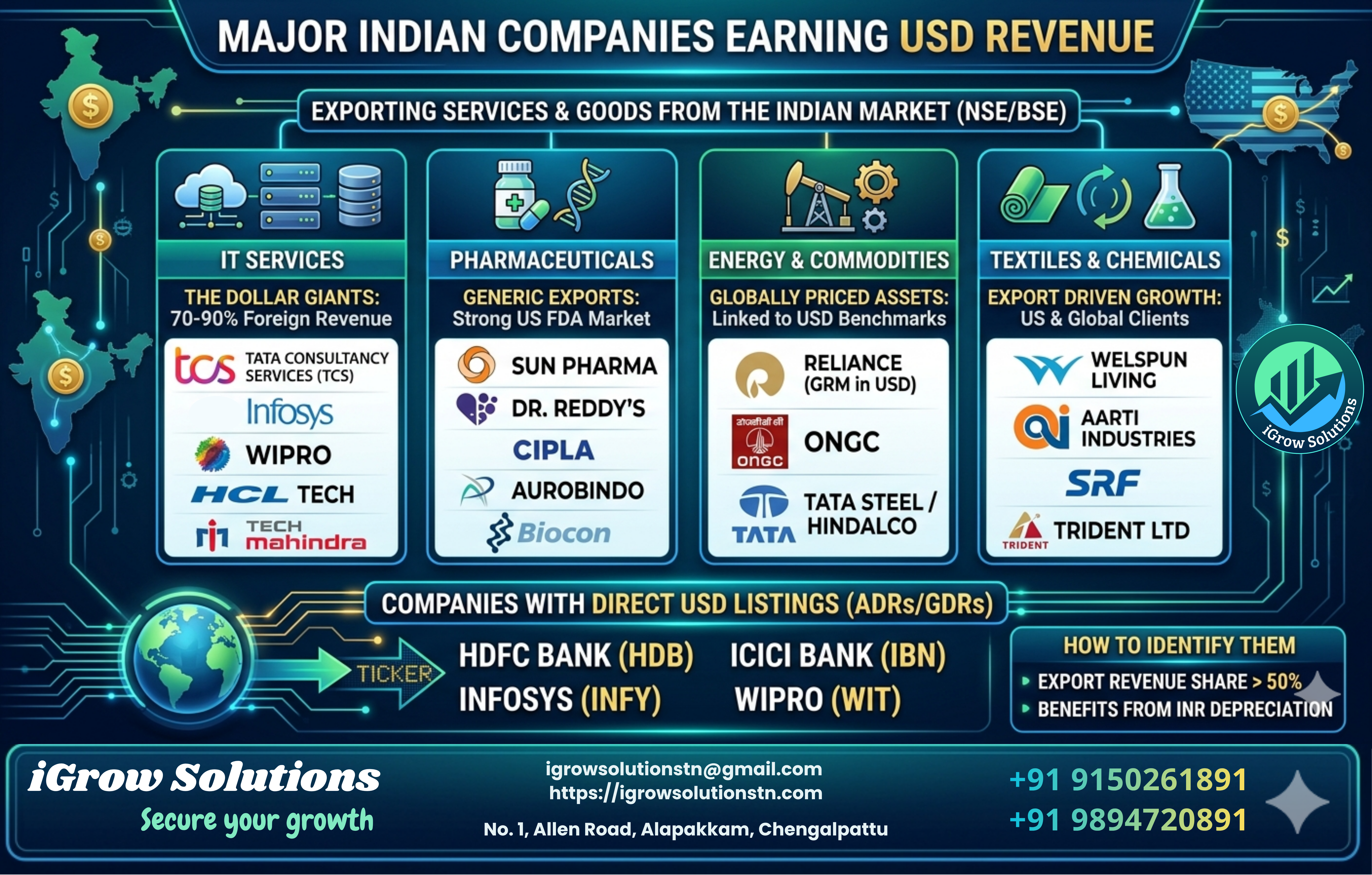
In the Indian stock market (NSE and BSE), companies are required to report their financial statements in Indian Rupees (INR). However, because India is a global export hub, a massive portion of the market earns the majority of its revenue in US Dollars (USD). These companies are primarily found in sectors where services or goods are sold to global clients (primarily in the US and Europe).

1. The IT Services Sector (The "Dollar Giants")

This is the most significant group. Most large-cap Indian IT firms earn 70% to 90% of their revenue in foreign currency, primarily USD.

1. Tata Consultancy Services (TCS): ~50% of revenue from North America alone.
2. Infosys: High exposure to US financial and retail sectors.
3. Wipro: Significant presence in US healthcare and energy markets.
4. HCL Technologies: Known for large infrastructure and engineering deals in USD.
5. Tech Mahindra: Heavily exposed to global telecom and US enterprise clients.
6. LTIMindtree: Strong focus on US high-tech and banking sectors.

2. The Pharmaceutical Sector (Generic Exports)

India is the "Pharmacy of the World," and these companies make a substantial part of their profit from the US FDA-approved generic market.

1. Sun Pharmaceutical: The largest Indian pharma company with massive US sales.
2. Dr. Reddy’s Laboratories: Listed on the NYSE as well; earns heavily from North American generics.
3. Cipla: Strong export portfolio in respiratory and HIV treatments.
4. Biocon: Major player in biosimilars for the US and European markets.
5. Aurobindo Pharma: One of the largest exporters of generic drugs to the US by volume.

3. Energy & Commodities

These companies deal in globally priced assets (Oil, Gas, Metals). Even when selling locally, their pricing is often benchmarked against USD "Import Parity" prices.

1. Reliance Industries (RIL): As a global refiner, its "Gross Refining Margins" (GRM) are earned and calculated in USD.
2. Oil & Natural Gas Corp (ONGC): Domestic oil and gas prices are linked to global USD benchmarks.
3. Tata Steel / Hindalco: Significant international subsidiaries (like Novelis) that earn entirely in foreign currency.

4. Textiles and Specialty Chemicals

1. Welspun Living: A leading home textile exporter to major US retailers like Walmart and Target.
2. Trident Ltd: High export share in towels and linens.
3. SRF / Aarti Industries: Specialty chemicals used by global pharma and agrochemical majors, priced in USD.

These are some leading companies in each category. However, do read each companies annual report and do valuation before deciding to invest in these companies.

2025-04-01

Investment starts with Saving

The goal of iGrow Solution is to enhance your financial security by helping you to make better investment decisions and leading to secured retirement. It doesn’t matter whether you make a return of 2%, 5% or even 10% on your investments if you have nothing to invest. Little by Little you can safely stock up a small reserve here, but not until you start. Best Practice: Reduce your expenses well below your income whether you are a college fresher or a multimillionaire. By saving you are going to have more freedom of choice both now and in the future. No regrets in future are important and no regrets in the present are important, too. “I should have” and “I wish I had” are the two saddest sentences in today’s world, which could be avoided by start saving. By making saving as a habit, you can turn into a sensible saver. Goal: The real purpose of saving is to empower you to keep your priorities – not to make you sacrifice. Savings can give you an opportunity to take advantage of attractive future opportunities that are important to you. Benjamin Franklin described compounding, “Money makes money. And the money that money makes, makes money.” Actual Case: When Franklin died in 1790, he left a gift of $5,000 to each of his two favorite cities, Boston and Philadelphia. He stipulated that the money was to be invested and could be paid out at two specific dates, the first 100 years and the second 200 years after the date of the gift. After 100 years, each city was allowed to withdraw $500,000 for public works projects. After 200 years, in 1991, they received the balance – which had compounded to approximately $20 million for each city. It's great when compounding is working for you but ghastly when working against you. That’s what makes credit card balances so dangerous. When you don’t pay credit card bill on time, you’ll be soon paying interest on interest – and interest on the interest on the interest.

2025-05-01

Low-Cost Investment Options

1. Index Funds Index funds eliminate the anxiety and expense of trying to predict which individual stocks, bonds, or mutual funds will beat the market. This simple investment strategy – indexing – has outperformed all but a handful of the thousands of equity and bond funds that are sold to the public. This is better option when you plan for your retirement funds. Nobody knows more than the market: It is difficult for most investors to believe that the stock market is actually smarter or better informed than they are. Most financial professionals still do not accept the premise – perhaps because they earn lucrative fees and believe they can pick and choose the best stocks and beat the market. Almost no investor consistently outperforms the market either by predicting its movements or by selecting particular stocks. However, it doesn’t mean that the overall market is always correctly priced. Stock markets often make major mistakes, and market prices tend to be far more volatile than the underlying conditions warrant. So don’t think for a minute that professional financial advice would have saved you from the financial tsunami. The Index Fund Solution: Because the players in the market must, on average, earn the market return and winners’ winnings will equal losers’ losses, investing is called a zero-sum game. If some investors are fortunate enough to own only the stocks that have done better than the overall market, then it must follow that some other investors must be holding the stocks that have done worse. The average actively managed mutual fund charges about one percentage point of assets each year for managing the portfolio. It is the expenses charged by professional “active” managers that drag their returns well below that of the market as a whole. Low-cost index funds charge only one-tenth as much for portfolio management and it do not need to hire highly paid security analysts for manage the portfolio. Professional managers underperform the market as a whole by the amount of their management expenses and transaction costs. That’s why active managers do not beat the market – and why the market beats them. Don’t Some Beat the Market? Sure, some managers do beat the market – but the quest ion is : will you, or anyone else, be able to pick the managers who will beat the market in advance? Nobody has been able to figure out in advance which funds will do better. Fund managers who succeeded in beating market will increase their management fee which will increase the expense ratio of their next fund. The financial media are quick to celebrate managers who have recently beaten the market as investment geniuses. Just because a manager beat the market last year does not mean he or she is likely to continue to do so again next year. Mutual fund “performance” is almost as random as the market. Chasing hot performance is a costly and self-defeating exercise. Pl. don’t do it. 2. ETFs ETFs are index funds that trade on the major stock exchanges and can be bought and sold like stocks. They often have even lower expense rations than index funds. They allow an investor to buy and sell at any time during the day and thus are favored by professional trades for hedging. They are even more tax efficient than mutual funds since they can redeem shares without generating ta taxable event. 3. Index Bonds: If indexing has advantages in the stock market, its superiority is even greater in the bond market. You would never want to hold just one bond in your portfolio – any single bond issuer could get into financial deficiency and be unable to repay you in full. That’s why it’s wise to use bond index funds. Advantages of Index Funds / ETFs: • They simplify investing: No need to evaluate thousands of actively managed funds to pick one • Index funds are cost efficient and tax efficient • They are predictable as they are aligned to equity index